


The AI Capability Gap: What it Means for Leaders and Insights Teams

You can pull a dashboard that shows what percentage of your insights team is "using AI." A lot of leaders are looking at that number right now and feeling reasonably good about it. The trouble is that the number tells you almost nothing.
Two researchers with the same license, the same tools and the same brief can produce work that lives in completely different galaxies. And while we know that yes, a majority of insights pros today are using AI, the adoption metric flattens all of that into a single reassuring percentage.
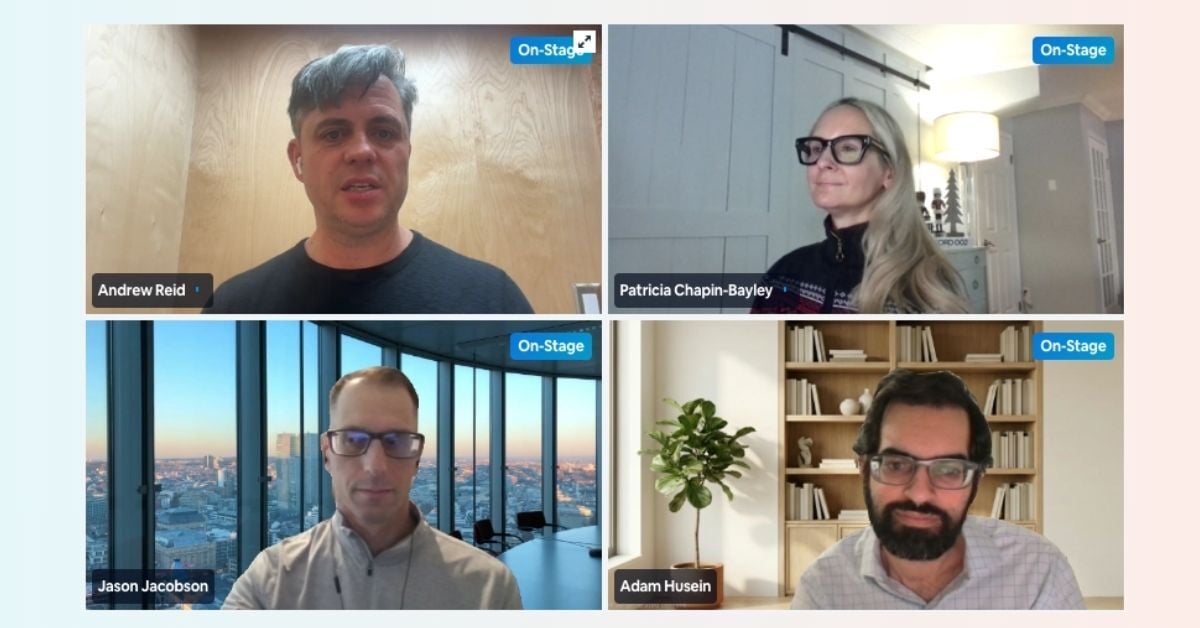
Andrew Reid, CEO and Founder of Rival Technologies, makes the case in Stop Measuring AI Adoption. The Capability Gap Inside Your Team Is the Real Reason You Are Falling Behind. that the whole adoption conversation is aimed at the wrong target. Who is using AI is easy to measure and increasingly beside the point. How well they use it, and how fast that skill is compounding, is where the real story sits. For anyone running a research or insights function, that distinction is worth sitting with.
Why "AI adoption" is a misleading metric
Andrew opens his article by pointing out many of us probably have already observed or experienced firsthand (I certainly have): AI's rollout is anything but smooth. Yes, it's a top market research trend in 2026 — but if we're being real, AI's impact on marketing, insights and other functions has been even bigger than what some of us anticipated.
"It is moving in step changes, where what felt like strong performance a few months ago quietly becomes the baseline, often without any clear signal that the bar has moved," Andrew points out.
That's the tricky party. There is no announcement when the baseline shifts. The tool you were impressed by in the spring is table stakes by the fall, and the people who noticed have already moved on.
Andrew describes three groups forming inside most organizations:
-
People who are using AI cautiously, at the edges of their work
-
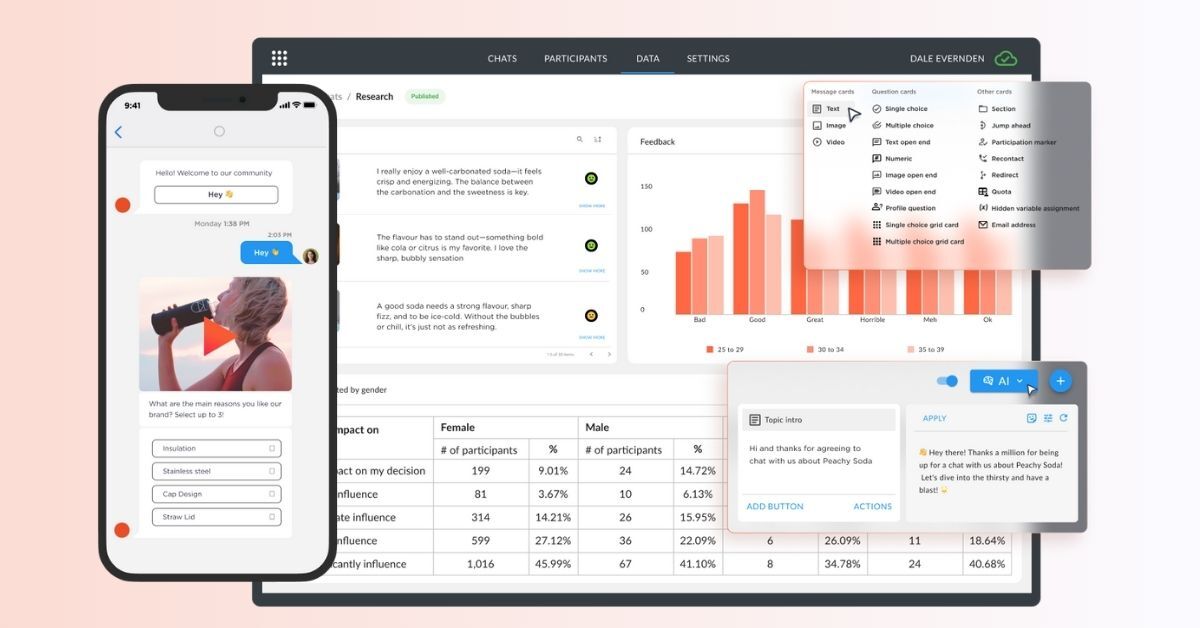
People testing ideas, using both generally available tools (like Claude and ChatGPT) and AI tools specifically built for researchers, such as those available on the Rival platform
-
People going much deeper, using open-source tools, pushing on the edges of what is possible and running “scary” experiments
"All three groups are using AI, but they are not operating at the same level," Andrew asserts. "That difference compounds quickly by changing how work gets done, how fast it moves and how people experience their roles day to day."
In an insights team, this shows up fast. One researcher is still hand-coding open ends while another has built a workflow that drafts the analysis plan, stress-tests the sample and produces a first-pass narrative before the first coffee. Same title, same team, radically different throughput.
That is not an adoption gap. It is a capability gap, and it is the thing your dashboard cannot see.
The job is moving from doing the work to deciding what the work means.
Most research roles were built around execution. Program the survey, field it, clean the data, code the responses, build the deck. Andrew's observation is that AI is compressing that entire layer, and the value is migrating somewhere else.
The work is shifting toward evaluating, connecting and deciding what matters. You can get to a first version of almost anything quickly now, which changes where a good researcher actually earns their keep. Less time assembling the output. More time interrogating whether it is right, whether it answers the real question, and what the business should do about it.
This is the same argument we have made about why AI didn't kill market research; it moved the center of gravity toward judgment. The teams treating AI-accelerated insights as a way to skip the thinking are missing the point entirely. The teams using the reclaimed time to think harder are the ones pulling ahead.
You cannot standardize your way out of this.
Here is where a lot of well-meaning organizations go wrong. Faced with fast-moving capability, the reflex is to get control of it: form a committee, write the best-practice guide, define the approved workflow and roll it out. Andrew is direct about why that fails. You cannot define in advance how a capability this fluid should be used and then push it down through the org, because by the time the guide is written the ground has moved.
At Rival Group, we started "AI Fridays" to give everyone time where people can step away from their day-to-day and focus on an AI project related to their role.
"These are small, facilitated groups, usually no more than ten people, with an AI implementation expert in the room the entire time," Andrew reveals. "People are expected to commit fully. No multitasking, no checking email. We block off a minimum of three hours because anything less isn’t enough to engage meaningfully."
Many of our researchers (including those from Rival's customer success team, as well as our sister companies, Reach3 Insights and Angus Reid), have participated in AI Fridays — with great success. A three-hour block where the quant team, the qual team and the ops team each push on their own workflows, then compare notes, surfaces things no top-down playbook would. It also normalizes the failed experiments, which matters, because a lot of this work does not pay off on the first try. When someone hits a dead end in a group setting, it becomes part of the process instead of something to hide.
That is exactly the kind of human-in-the-loop practice that separates teams that get better from teams that just get busier.
Speed is not a license to stop owning the work.
For all the talk of compression and acceleration, Andrew is clear that one thing does not move. The baseline expectation of accountability holds no matter how the work was produced.
” If something is being shared or used to make a decision, it needs to be understood and owned. That applies regardless of how it was produced.
Andrew Reid, CEO and Founder, Rival Technologies
This one should land hard for researchers, because credibility is the entire product. A finding that no human on the team can defend is not an insight. It is AI slop in a nicer font. The fastest-moving teams are not the ones who trust the output blindly. They are the ones who move fast to a first draft and then apply the same rigor they always did to make sure it holds up.
Andrew names the specific way leaders create this problem for themselves. They spend time with the tools, their own sense of what is possible quietly ratchets up, and then they never say so out loud: "The team ends up trying to catch up to a standard they cannot see, and that is where the disconnect starts."
If you are the person whose expectations have shifted, the shift is your responsibility to make visible. Otherwise the team is being graded against a bar it was never shown.
What leaders can do about the AI capability gap
The uncomfortable truth in Andrew's piece is that capability compounds whether or not you are paying attention to it. Every week, the distance between the people going deep and the people dabbling gets a little wider, and no adoption metric will warn you it is happening. The leaders getting ahead of it are not the ones with the most licenses deployed. They are the ones deliberately building the time, the milestones and the incentives for their teams to keep leveling up, and then owning the new standard out loud instead of keeping it in their heads.
In his article, Andrew offered specific recommendations for leaders on how to tackle the AI capability gap:
- Own the responsibility for driving change as expectations shift
- Create the space for focused experimentation
- Set clear, meaningful milestones that are ambitious enough to push teams to change how they work
- Demonstrate through incentives that leaning into the AI shift leads to real upside, not just more work
Ultimately, leaders need to stop asking who on the team is using AI. Instead, start asking how good they are getting, how fast, and how they're measuring the impact and ROI. That is the question that actually predicts where your function lands a year from now.
To go deeper on how this is reshaping research specifically, our take on AI and the future of research and insights in 2026 picks up right where this leaves off.
The Researcher's Guide
to AI ROI
see how to stack up





























.jpg)




















.jpg)










-1.jpg)


.jpg)

.jpg)