


Building a High-Impact Insight Community: Lessons From The Knot
Let’s be honest. Your response rates aren’t getting any better. Your executives want answers by lunch. And the deck you spent three weeks on? Skimmed, then forgotten, by people who still can’t quite picture your customer.
If that stings a little, you’re in good company. Most insights teams are being asked to move faster, prove more, and stay closer to customers, often with the same email surveys participants stopped finishing ages ago. A well-run insight community is one of the best ways out. It works when you build it around the business instead of the research calendar.
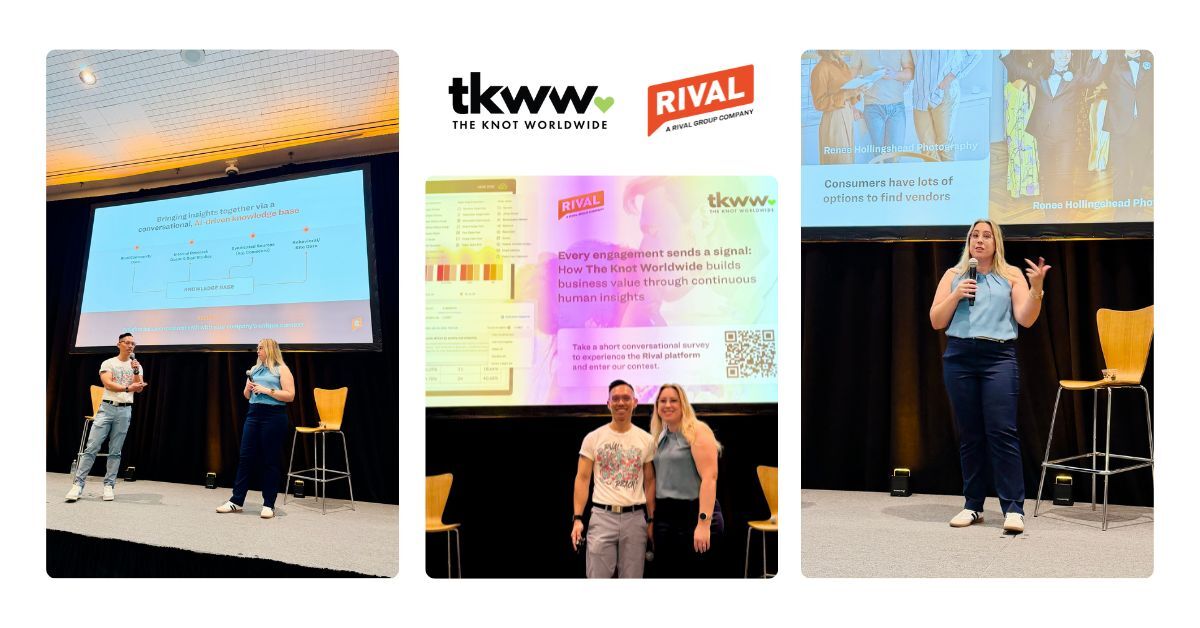
In a recent Greenbook webinar Sam Joneswood, Insights Lead at The Knot Worldwide, joined Andrew Reid, our CEO and Founder at Rival Technologies, to show how The Knot’s insight community is helping drive customer obsession and agile decision-making. Whether you’re actively weighing top insight community companies or figuring out how to work with an existing community, Sam’s approach is worth borrowing.
A recording of the webinar is available here. Here are some of the key takeaways from the webinar.
Insight community lessons and examples from The Knot
1. Start with the “why” your data can’t give you
First, some context: The Knot is a two-sided marketplace that connects couples with wedding professionals. It serves four million users, supports 900,000 wedding pros, and operates in 10 countries. The customer lifecycle is short, about 14 months from proposal to wedding day, so Sam’s window to reach people is tight. That’s exactly why a continuous community beats one-off projects.
Given its popularity, The Knot had plenty of people and plenty of data. About a million net-new users had signed up on The Knot alone, and the team had strong web and behavioral analytics. The one thing missing was the reason behind the clicks.
“Where we were struggling is the why," shared Sam. "We were missing the concepts of what was motivating someone, what was behind those decisions when they were choosing to book a DJ or not book a DJ.”
Before launching their community on the Rival platform, the team couldn’t explain the motivation behind booking decisions. Their relatively new leadership wanted to know what was coming next for weddings. And they had little visibility into relationship milestones, the “vacant middle” between someone dating for six or eight months and someone ready to say “I think this is my person.”
The community, now in its second year and approaching its third, was built to fill those gaps with ongoing feedback from engaged couples.
For anyone running an insight community, the lesson is to list where your analytics stop and your “why” questions begin. Let that list shape what your community is for.
2. Anchor the community to a leadership mandate
The Knot has a relatively new CEO, and in her short tenure, she wanted teams to focus on one important thing.
“The mandate from our CEO was to bring our customers closer to any employee here at The Knot Worldwide," Sam shared.
Employees knew in theory who the customer was, but couldn’t put a face to one. So Sam’s team created moderated focus groups and branded them “listening sessions,” a name that fits the company’s own language. They recruit participants for those sessions straight from the community, which lets them go deeper on users’ needs and mindsets.
If you run an insight community, your leadership probably has a version of this mandate, even if nobody has said it out loud. Find it, and design your first few research programs around it.
3. Know who will act on the answer
During the webinar, Sam shared some specific case studies on how they're using their community to solve real business challenges.
In one example, she shared how the company saw a gap between what couples want and what vendors expect in communication. Couples were saying one thing, vendors another. Sam’s team ran a longitudinal study that followed currently engaged couples through their multi-month, multi-category vendor search. The data went primarily to the product team that owns the vendor inbox, a DM-style messaging tool.
The result was practical. The product team built in-product reminders that flag a stale conversation, plus AI prompts that let a couple pick a quick reply such as “I’m all set, thank you so much.” The marketing team also now encourages couples to close out conversations with vendors they didn’t book. Why does that matter?
Before your next study, be clear on who will act on the answer and what they’ll do differently. Then make sure you're sharing your insights from your community to help them make the right decisions.
4. Meet participants where they are
Before Rival, The Knot ran its community over email using one of the most popular market research tools. Sam was candid about how that felt.
“You can do a lot there, but it’s not perfect. You just kinda make it work," she revealed.
Completes were still coming in, but getting couples to actually engage was getting harder. Meanwhile, couples do much of their planning on their phones.
So mobile-first topped her insight community evaluation checklist, followed by speed on both quant and qual, video at scale, and easy member management. Her leaders also expect results fast, sometimes the next day.
The advice from both Sam and Andrew is to design research activities that your insight community members will actually love. Shorter, more frequent conversations on mobile will keep people engaged and coming back over time.
5. Build profile variables so you stop re-screening
This is one of Sam’s favorite wins.
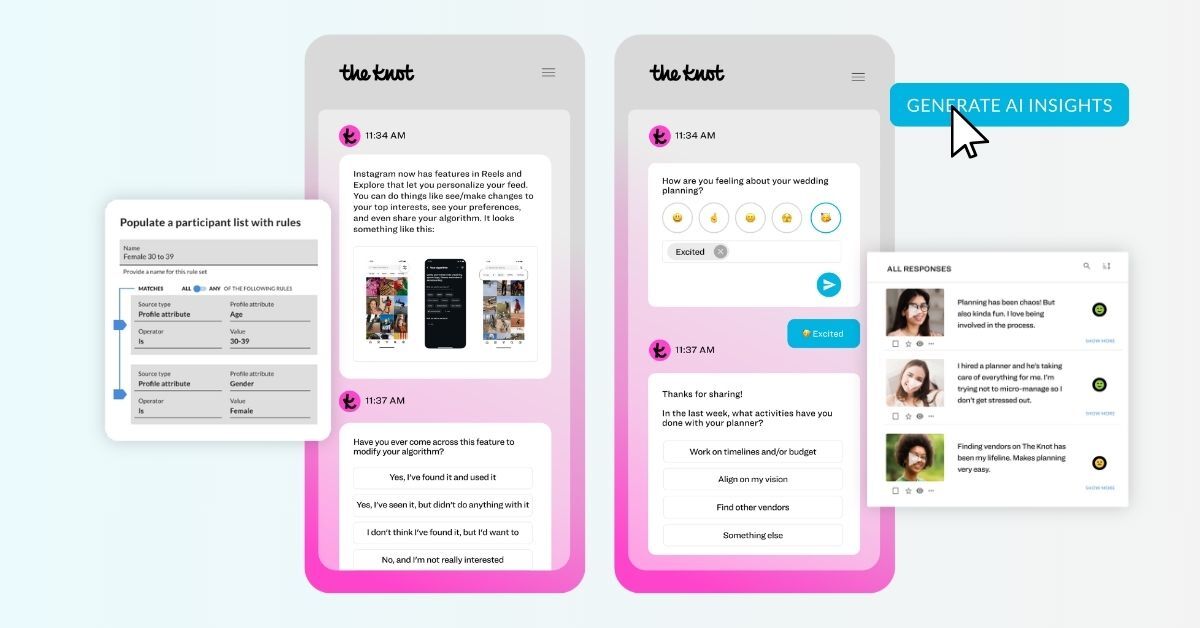
Rival’s profile variables are attributes stored on each community member. Now Sam checks in instead of starting from scratch. She might prompt a participant with, “Last chat, you told us you were working on your invitations. Is this still accurate?” If the answer is no, the participant goes back and updates their profile. That means no lengthy screener at the start of every survey, and chats and research opportunities that fit each person.
“It just allows me to already know them and know what’s a good fit for them," Sam said.
If you run an insight community, your profile data is one of your biggest assets. Keep the fast-changing attributes fresh, and you’ll recruit faster while your participants feel known instead of screened.
6. Run qual and quant as a loop, and let hypotheses be wrong
In another case study, Sam shared how they asked their community about the practice of algorithm hacking—in particular, if they use Instagram's My Algorithm feature.
The study started in a moderated focus group. Couples kept describing the same thing, so Sam’s team took that hunch to the community as a quick pulse. Through a conversational survey, they showed participants a picture of Instagram’s My Algorithm feature so everyone knew exactly what was being asked, because they wanted to understand how much the platform was driving the experience versus couples themselves.
The answer split by audience. Currently engaged couples rarely tweaked their algorithm, and several asked, “This is a thing?” Pre-engaged couples, meaning people seriously dating and likely to get engaged within a couple of years, were already tuning theirs.
The findings let The Knot know that the issue is not urgent yet. “We don’t need to make a solve tomorrow," Sam said. "However, we need to be setting up plans now in the next two to three years.”
Another case study is about product hacking. The Knot got the idea from news about how people used Strava’s heat maps in unexpected ways, and wondered whether couples were inventing creative workarounds.
“Folks aren’t really using our platform necessarily in novel ways, but they do have the instinct to explore," revealedSam.
Couples were rediscovering features that already existed through trial and error. So the team is now working on guided feature tours.
The lesson for researchers is to let qual spot the hunch, let your insight community size it, and go back to qual for the story. Write your hypothesis down first. When it turns out wrong, you’ve probably found something better.
7. Socialize relentlessly, and put the customer on screen
The Knot shares what its community says in several ways: monthly newsletters, all-hands meetings with slides, and an annual year-in-review deck that now doubles as onboarding for new hires. The biggest win has been embedding customer videos from community members in executive presentations and onboarding.
” Leaders can hear directly from couples in their own words what the challenges are, what the wins are.
Sam Joneswood, Insights Lead, The Knot Worldwide
Andrew shared why this matters, pointing to a retrospective on Allbirds that described an executive marketing to a fantasy customer instead of the real one.
“That constant reality check and that reorientation to your customer is important," Andrew reiterated.
Sam’s advice is refreshingly simple: “Just take every opportunity you can to share what you’re learning about your customers.”
Andrew’s point is worth keeping in mind: “That study you did with those individuals drove a decision, and that decision created a great outcome.”
For your own insight community, treat socialization as a standing campaign with a cadence and owners. Put a participant voice in every channel, and build in a check on whether decisions worked.
What to look for in an insight community platform
Sam’s selection criteria double as a checklist for any insight community platform:
- A mobile-first participant experience
- Speed on both quant and qual
- Video at scale
- Easy member management
- A support team that understands community, recruitment, and incentives
On that last point, Sam said of her Rival customer success manager, “It feels like she is an extension of our own team.”
If you’d like to see how an insight community could work for your business questions, we’re happy to chat

.jpg)