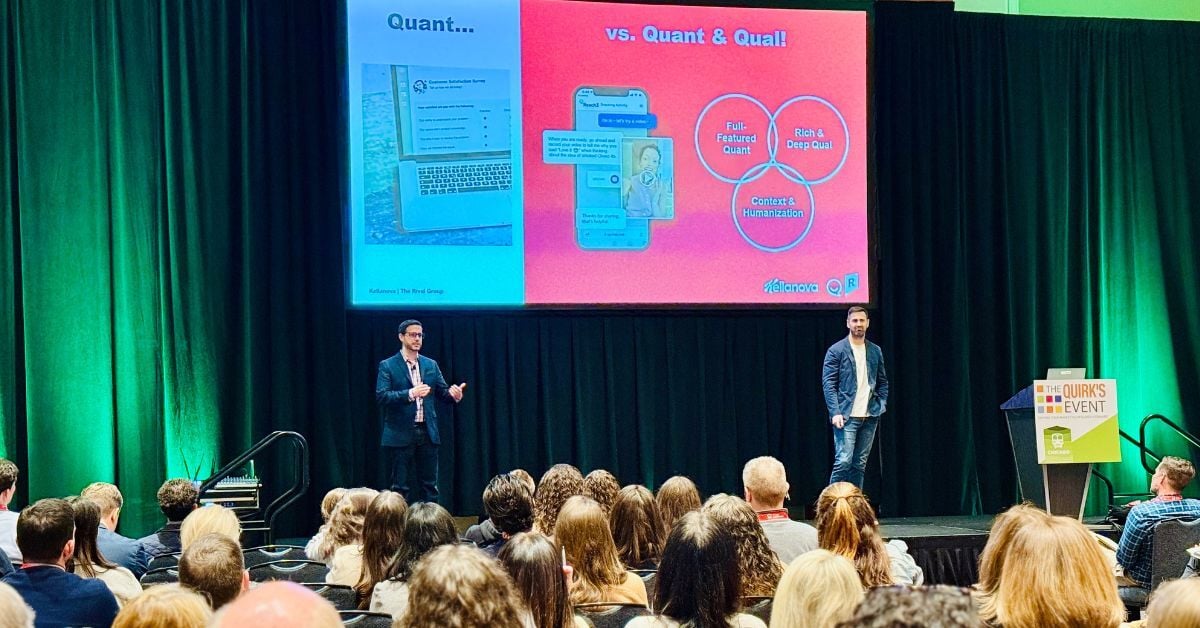



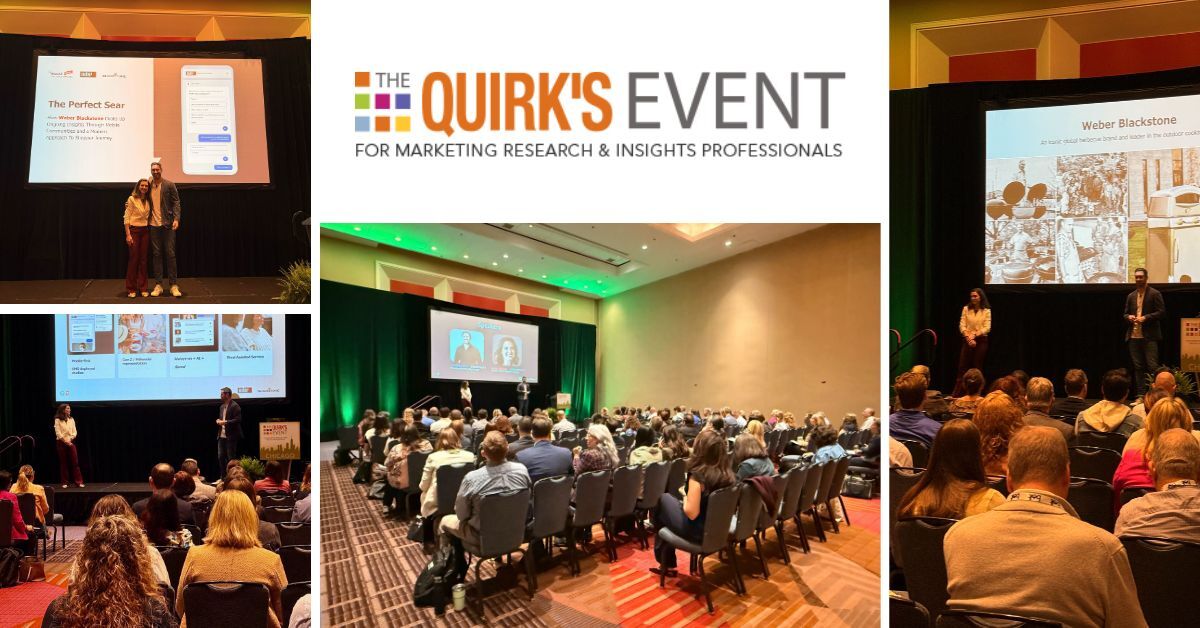
At Quirks Chicago 2026, Laura Ammigan, Global Director of Insights and Analytics at Weber-Blackstone, joined Jonathan Dore, EVP at our sister company Reach3 Insights, on stage to share what a modern insights partnership looks like today.
Laura's team is made up of just two people. Her stakeholder list? A lot longer than that. So, how do they manage to elevate the role of insights given their limited resources?
During their presentation, Laura explored some of their strategies.
An insight community built for the phone in your pocket
Weber has been running insight communities since 2018, but the team really found its stride on the Rival platform. Called Barbecue Circle, their communities now span four countries, with about a thousand grillers in each community, and it's genuinely mobile-first — not just mobile-optimized.
The distinction matters. There's no portal to log in to. Members participate in conversational surveys, diary studies, and photo and video missions all via their smartphones. Members get a text with a link when something new is ready, and the activity opens in a conversational, messaging-style flow on their phone. It feels less like taking a survey and more like texting with a friend who's curious about grills.
That lightweight model is what lets a small internal team scale across four countries — and makes it easier to engage the millennial and Gen Z grillers most categories struggle to recruit.
As they also explained in a recent webinar, Weber's communities are deliberately mixed — combining current Weber customers and non-customers — and softly branded at the door so recruitment is about barbecuing, not a specific brand.
This lets the insights team provide objective insights to different stakeholders. "We like to position ourselves kind of as like Switzerland," Laura told the room. "We're the neutral party, and we're the consumer."
When teams disagree on a business question, Laura's team bridges the gap. When a stakeholder has a question, the insight community is already there — and because the budget is covered, there's no "I can't afford to ask" moment.
.svg)
Delivering high-quality feedback to global stakeholders with limited budget
Running a global community with a two-person team isn't supposed to be possible. Laura credits the assisted-service model — a partner close enough to the work to pick the right GIFs, write conversational survey copy, and keep the community healthy.
"It's just been a huge, huge help and a very big extension of our team, which is two of us."
The Germany study that flipped an internal narrative
The community is the always-on layer. When a bigger strategic question comes up, the team layers a project on top — which is exactly what happened in Germany.
Internally, stakeholders were confident on what they perceived as the story: we're losing in Germany because we don't have a specific feature a competitor built into a low-end grill. Until we build it, we can't win.
Laura's team hit pause and asked consumers if that's really what's happening. They built a blinded shopper journey — quant with advanced analytics (TURF on regression), a mobile recontact into a qual phase with in-store photo and video missions, and AI probing on open-ends.
What came back wasn't the feature story. In Germany, value sat right at the top — something no one had hypothesized. Heat mattered, but as part of a bigger value conversation. The real issue wasn't the product. It was how the product was being talked about.
"We actually can make changes to our messaging with our current product, and here's what it needs to say. Here's what you need to bring to your merchandising, your POP — all things you can action on in the next season."
It just gave us credibility as an insights organization that we were forward-thinking and could really influence the strategy.
A very different conversation than "build a new SKU and wait two years." The timing also happened to be perfect — the Blackstone merger had just reshuffled the org chart.
"It just gave us credibility as an insights organization that we were forward-thinking and could really influence the strategy. In Germany, it was a big deal because Blackstone wasn't in Germany — we could show them a whole market they didn't know anything about, right off the bat."
Storytelling with insights: Not another 70-page deck
Laura's take on reporting was refreshingly blunt:
"Our stakeholders probably don't have time to look at a 70-page deck. They also probably don't want to learn all the methodologies you're going through."
To tell effective stories, the team keeps it fresh — real-time dashboards, AI-surfaced themes from qual, digital top-lines executives can scroll on their phones, video show reels, and the occasional full PowerPoint. The magic is the stacking. When quant, analytics, photos, and video all tell the same story, it stops being arguable.
"When you actually see all of these things stacked up, and they're telling the same story, the story is sticky. It makes our message come across that we did our due diligence, and that we care about it enough to put all of this rigor behind it."
What makes an insights partnership work
Three ingredients, working together: an always-on community that's cheap to tap, ad-hoc strategic projects when the question is bigger, and a suite of deliverables that meets every stakeholder where they are. It's what lets a two-person team behave like a much bigger one.
Huge thanks to Laura for being such a great partner and for sharing so openly at Quirks.
If you'd like to learn more about Weber's insight communities, check out a recording of our webinar here.
.jpg)