



You know the moment: someone shrugs and says they "don’t really have a preference" — then orders the same brand every single time. That gap between what people say and what they do? That’s where implicit research lives.
Today, implicit research is one of the biggest market research trends, and for a good reason. More and more brands are realizing that the loudest feedback isn’t always the most useful. Sometimes, the most honest reactions come from what’s unspoken.
So, what is implicit research?
It’s not new, but it is newly important. Implicit research focuses on the fast, subconscious reactions that shape behavior — the kind that happen in milliseconds before your rational brain has time to weigh in. Think gut feeling, facial expression, or even how long it takes you to associate a logo with a feeling.
It’s rooted in the behavioral science concept of "System 1 thinking," coined by psychologist Daniel Kahneman. That’s the quick, instinctive mental system responsible for most of our decisions.
When participants respond without overthinking, you get closer to their real attitudes, not just the polished, post-rationalized versions.
Why implicit research matters in customer insights
Today’s consumers move fast and feel faster. They’re bombarded with content and choices — and they often decide based on emotion, not logic.
Traditional research approaches ask people to explain themselves after the fact. That works for some things. But it won’t capture the full picture.
Implicit methods are useful in customer research because they let you:
-
Uncover emotional drivers and motivations behind decisions
-
Spot disconnects between what people say and what they feel
-
Tap into authentic, in-the-moment reactions
In a world where brand loyalty is fragile and attention spans are microscopic, tapping into what people feel (not just say) gives you a more honest signal.

Business use cases for implicit research
There are a lot of use cases where implicit methods might help. It can help with everything from shopper insights to early-stage product innovation research.
One area where implicit methods can be especially powerful is when looking for whitespace opportunities. When participants can respond instinctively—without trying to explain or justify—you uncover unmet needs they may not even be aware of.
That emotional first response can reveal tensions, aspirations, or emotional gaps in the market that traditional research might miss. It's also useful for fine-tuning creative, predicting in-market behavior, and exploring brand loyalty in more honest ways.
Basically, anytime you're asking "What aren't we seeing?" or "Where's the friction?", implicit research helps you go beyond the obvious.
How to do implicit research
Many implicit research techniques involve watching or observing what people do. For example, ethnography (both in-person or mobile-based) can provide context on shopping occasions and other factors that lead to a decision.
When done right, conversational surveys can also dig into System 1 thinking. But you have to set it up in a way that lets people put their guards down and share faster and more authentically.
The best implicit research tools don’t feel like research at all. They meet people where they are, keep things conversational, and encourage fast, natural reactions. That’s where Rival Technologies comes in.
How Rival Technologies makes implicit research work
Rival Technologies helps you capture those split-second, instinctive reactions through tools that feel more like texting a friend than taking a test.
Here’s how:
Conversational formats: Rival turns traditional surveys into mobile-first, chat-style experiences. When people feel like they’re having a real conversation, they respond more naturally. In fact, according to Wharton School of the University of Pennsylvania, people disclose more when they respond using their phone.
“When we engage in a certain task on our phone, it makes us feel more psychologically comforted than when we engage in the exact same task on our laptops.”
-Shiri Melumad, Wharton School at the University of Pennsylvania
In-the-moment feedback: Because it all happens on mobile (no app needed), you can reach people while they’re watching your ad, leaving your store, or trying your product. In-the-moment research reduces recall bias — which is critical in uncovering hidden truths.
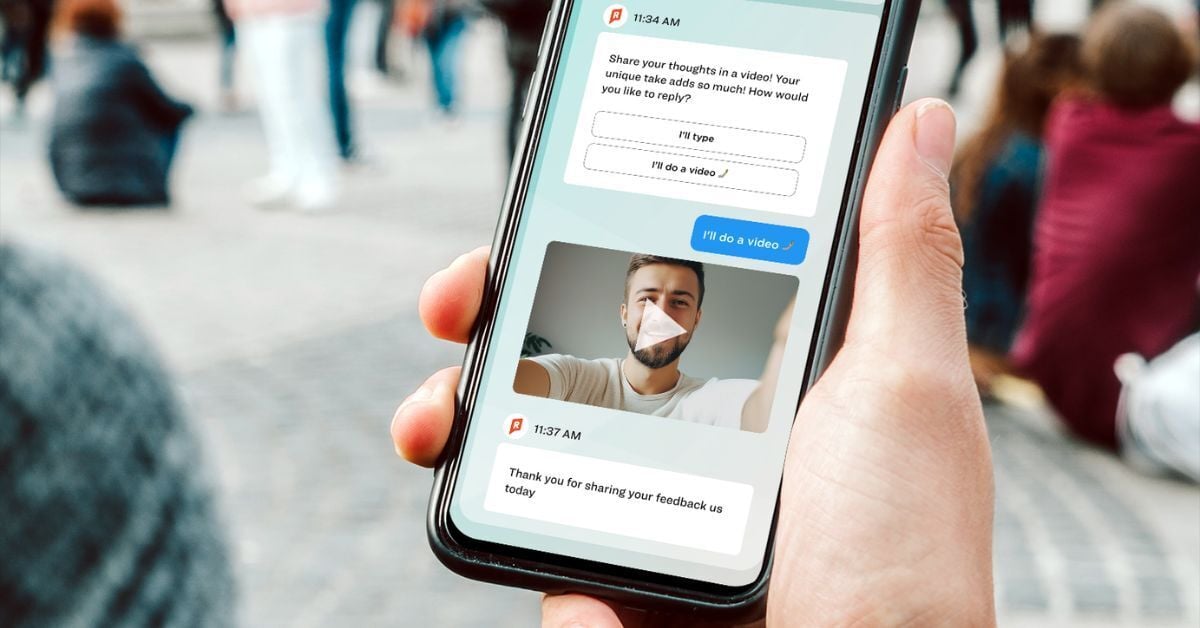
Video responses: People show how they feel before they say it. With async video responses, you capture emotion, facial expressions, and energy you’d never get in a static survey.
.png?width=1200&height=642&name=Video%20sentiment%20analysis%20-%20Topline%20on%20the%20Rival%20platform%20(laptop).png)
AI sentiment and tone analysis: Rival’s AI tools make it easy to analyze patterns and themes across unstructured data. Real-time sentiment analysis gives you a quick look at how people feel.
Emotional elicitation exercises: Bridging emotion and reflection
What we’re talking about here isn’t about abandoning questions, but about asking in smarter, more intuitive ways.
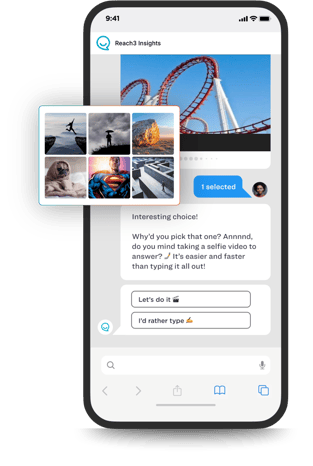 Our sister company Reach3 Insights, for example, uses the Rival Tech platform to use emotional elicitation exercises that bring together System 1 and System 2 thinking. Instead of asking consumers directly how they feel, participants are first shown a curated set of images that might capture their emotional response. Only then are they asked why they chose a specific image.
That small shift—starting with emotion, then moving to reflection—creates a bridge between instinct and reasoning. It helps participants articulate feelings they may not have recognized consciously, and the resulting explanations are consistently richer, more nuanced, and more authentic than what we get from traditional “how do you feel” questions.
Matt Kleinschmit, CEO and Founder of Reach3 Insights, thinks implicit research methods like emotional elicitation exercises are one of the biggest market research trends in 2026:
“To understand what people actually think, feel and do, we need to go beyond traditional research approaches. In 2026, we’ll see faster adoption of AI-accelerated, mobile techniques. By delivering immersive and immediate feedback, these conversational approaches help reveal the underlying dynamics driving decision-making.”
Hot tip: Implicit and explicit aren’t rivals
You don’t have to choose between what people say and what they feel. The most powerful insights come from combining both.
Ask a question, watch a reaction, and follow up with a “why?” But also ask for photos and video feedback to get more nuanced insights. Triangulating different sources of feedback is how you get to the truth about your customers.
If you want to know how people really feel, stop waiting for them to spell it out. Pay attention to the moment before the moment — the eyebrow raise, the pause, the knee-jerk click. That’s where the gold is.
And that’s exactly what Rival Technologies is built to help you find.