



AI makes it easy to produce insights but it doesn't guarantee they're any good. Here's a practical gut-check for insights professionals who want to move faster without losing the standards that make their work impactful.
Your stakeholders need answers faster than ever, and AI helps you deliver them. But somewhere between the prompt and the presentation, a question tends to surface: is this actually true?
The hardest moment in any stakeholder meeting is the pushback. When someone questions your findings, the methodology used to get there is suddenly on trial. In an era where AI can generate research outputs in minutes, how can we distinguish wether those insights reflect genuine human perspective, or just a plausible-sounding approximation of it?
Why data quality is the biggest risk in AI market research
AI is very good at making most data look authoritative and can easily create findings that read like insights from literally anything. But polished output tells you nothing about the quality of the underlying data used to generate it. We all know the quality of input determines quality of insight. That’s not new in research. It's just that when AI makes output this easy, it's tempting to stop paying attention to what went into it.
Before trusting an AI-generated output, ask: what was this built on? Real people, responding thoughtfully, through a methodology you can explain? Or thin open-ends where half the responses were three words long? Most AI tools can work with any level of data to make something convincing. The problem surfaces later, when stakeholders start asking the harder questions and the findings don't hold up.
Watch for AI slop in your own work
There's a useful name for AI output that looks complete but says nothing: slop. In our industry, slop could be something like...
- A brand perception summary that could apply to any competitor
- An insight deck headline that was a trend cliché before your study even fielded.
- A consumer persona whose defining trait is “values convenience”
Take this slop insight vs. real insight comparison:
“Consumers value convenience, affordability, and quality when choosing products in this category. Brand trust also plays a role.”
Vs
“Price sensitivity spikes when delivery exceeds 2 days — suggesting speed, not price, is the primary conversion driver.”
The slop version isn’t wrong. It’s just useless. It won’t change a decision, and any of your stakeholders could have written it without any supporting data at all.
A simple test: does this finding tell you something you couldn't have guessed? Real insight is specific enough that it only makes sense in the context of your data — your respondents, your category, this moment in time. If it reads like conventional wisdom with a number attached, the AI gave you a summary, not an insight.
Five questions before you present AI-assisted insights
- Can you point to the source? Real respondents, a methodology you can explain, verbatim responses that reflect genuine thought.
- Is it specific enough to drive a decision? Not “customers want better experiences” — but what specifically, where in the journey, and what would change if you fixed it.
- Does it surface tension or surprise? The most useful insights often involve contradiction. If everything in the summary sounds harmonious and expected, AI may be averaging away the signal.
- Have you spot-checked the themes against raw responses? Even 10–15 verbatims can tell you whether the AI’s categorization reflects what people actually said.
- Can you present this with confidence? AI can portray a study that received 40 one-word answers with the same authority as one from 500 rich open-ends. The output won't tell you the difference — you have to know what’s going in.
Where AI market research works — and where it falls short
There’s no question that AI is excellent at handling volume: digesting thousands of open-ended responses, identifying recurring language, surfacing themes that would take an analyst days to compile. Used well, it frees your team for the interpretive work that actually matters — applying the judgment that turns findings into effective stories that influence decisions.
Where AI struggles is judging the quality of what respondents actually said. Short, reflexive open-ends give AI thin material to work with — but it will work with it anyway and produce something that looks passable (even if it’s not valuable).
This is where the underlying methodology matters as much as the technology. When surveys feel like a test — a list of questions to get through as fast as humanly possible — responses reflect that back: short, surface-level, and shaped more by survey fatigue than genuine thought.
Why conversational research produces better AI insights
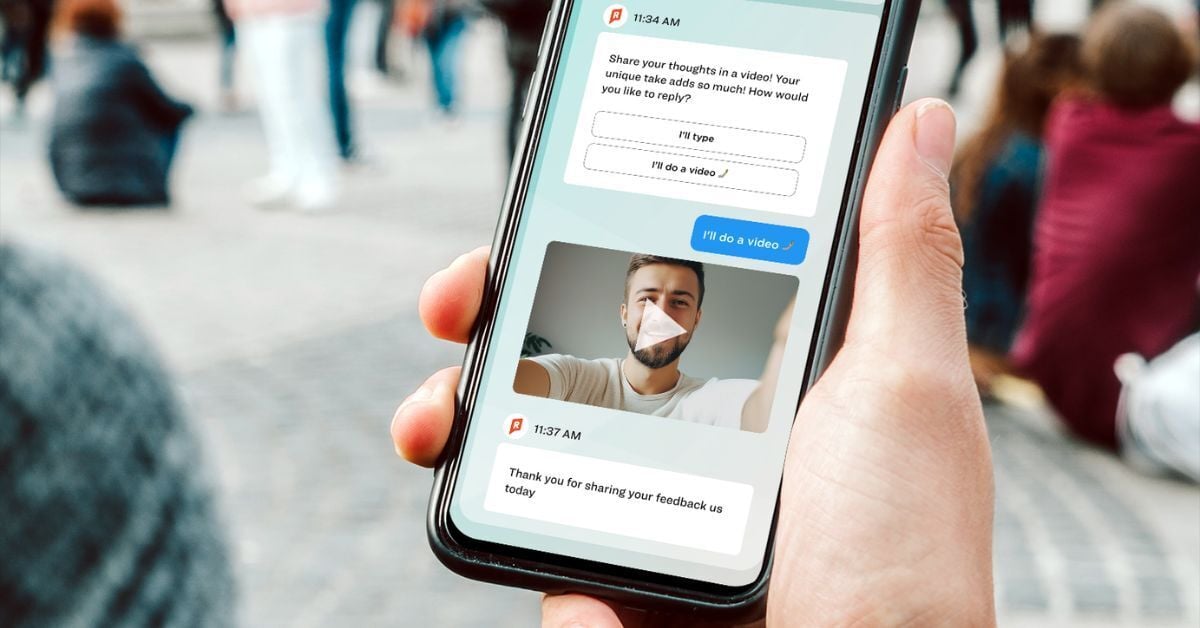
Rival's conversational approach changes the foundation. Chat-like surveys delivered via SMS and messaging apps — with unlimited video responses — naturally produce richer, more candid answers before any AI gets involved.
Then the AI layer compounds it.
Other platforms offer follow-up probing, but the questions are pre-set — fired automatically regardless of what the respondent said. Rival's AI Smart Probe only triggers when the Thoughtfulness Score™ determines a response warrants it. The score evaluates the thoughtfulness of open-ended responses across 10 research-grade dimensions—guiding follow-up probing questions and giving researchers confidence in response quality.
The result: open-ended responses that use the AI Smart Probe are 300% more thoughtful than traditional open-ends — which means the themes that surface afterward are grounded in something worth surfacing.
-Jun-24-2026-08-40-51-8225-AM.svg)
How to know if your AI research findings are actually reliable
The reason some insights professionals are skeptical of AI outputs isn't that the tools are bad. It's that there's no reliable signal telling you whether a given output is trustworthy without already knowing the answer. Everything looks like an insight until someone asks a hard question.
Rival's analysis doesn't just surface themes — it attaches confidence scores to them. Each theme is underscored by verbatims measured for relevance and sentiment, so you can see exactly what’s behind each finding rather than taking the output at face value. The themes that come out the other end aren't just AI's best guess — they're scored, traceable, and defensible.
.png?width=650&height=500&name=AI%20Insights(650%20x%20650%20px).png)
The judgment is yours, we can help
AI isn't going anywhere — and the insights professionals who are future-proofing their practice aren't waiting for permission to use it. They're using it to handle the volume, go deeper on qual, and get to findings faster than was possible even two years ago. The real decision is which tools and market research platforms will get results worth staking your reputation on.
Rival is building toward a world where every insight team, regardless of size, has the tools to move fast, go deep, and deliver the kind of human truth that actually changes decisions. Our vision for AI isn't to replace the researcher — it's to make them unstoppable.
If you're evaluating how AI fits into your research practice, book a demo, we'd love to show you how Rival can work for you.