It’s not just what questions are asked but how they’re asked.
By now, we all know that key to cultivating a creative business—one driven by innovation—is to ask lots of questions. Warren Berger wrote a best-selling book about this back in 2014, called A More Beautiful Question: The Power of Inquiry to Spark Breakthrough Ideas—which laid out the path to innovation in three parts: Why? What if? And How?
A good example of the Why-What If-How paradigm is the origin story of the Polaroid camera. It started, as Berger explains, with a Why question from the daughter of Polaroid co-founder Edwin Land: Why did it take so long to see the photographs Land had just taken, using a traditional camera? That “why” led to a “what if”: Could he build a darkroom within the camera? And then, “how”: What combination of chemicals and paper would make that magic happen? In 1948—five years after that first question was asked—the instant camera was born.
Market researchers help companies stay innovative by asking important questions of consumers all the time. But we also know, from experience, that it’s not just what questions are asked but how they’re asked; in the media maelstrom facing consumers today, many people speed through traditional surveys, doing anything to get to the end.
Here are six things to consider—from context to timing to tone—when building your survey of “beautiful questions,” while ensuring that the experience is both fruitful and enjoyable:
1.Show that you understand the brand personality.
Brands that are fun and edgy speak a different language. Take Revolt Media, Sean “Diddy” Combs’ digital media company dedicated to urban contemporary music. They have a large mobile community, which we do research with, and use words I barely understand (like “that’s really wig,” which means something so good your wig flies off your head). If I sent one of these Revolt surveys to some of my colleagues, it might go over their wigs. But the slang and tone makes sense for Revolt’s audience.
2. Mirror the way actual human conversation works
When I’m talking with a friend, there is a natural cadence: one person says something and the other person responds (“I really enjoy hiking in the mountains.” / “Yeah, hiking is great. What do you like most about it?”). It’s all about listening—then acknowledging what was said. You don’t throw away the research script, but by “piping” part of a consumer’s response back into the next question, you’re keeping them engaged in organic conversation.
3. Make your survey “snack sized”
Asking one question doesn’t give you enough to drive much insight. But asking somebody 30 or 40 questions guarantees you lose them forever. Consumers don’t want a survey experience that takes more than two or three minutes—max. While there may be a subset of people, like retirees, who will happily spend hours doing your survey, just about every other demographic is looking for a survey that’s short and sweet.
4: Balance “things I want” with “things you want”
A meeting host rarely dives into Agenda Item No. 1 without a warmup. A journalist won’t start an interview without an icebreaker. In any serious conversation, it’s never 100 percent about business. Think about when you have to give somebody criticism: You offer up a “praise sandwich,” with the negative feedback sandwiched between two positives. Same thing with surveys: along with the necessary client questions—“the meat”—ask some questions that show you care about the consumer.
5. Be vulnerable and share back
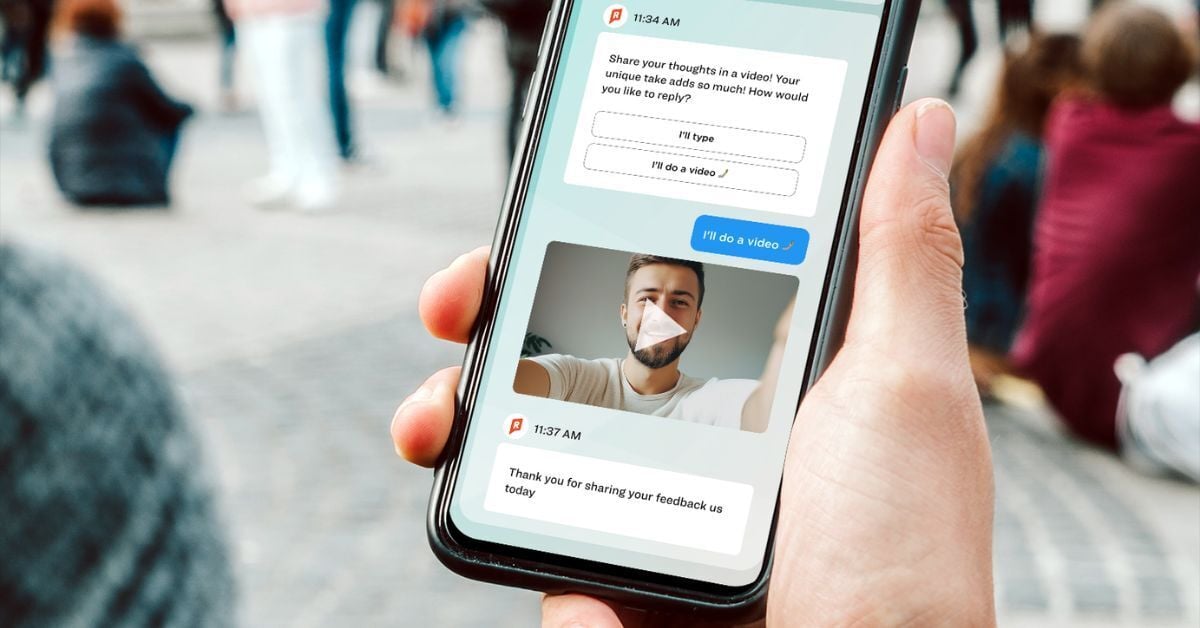
If you expect consumers to give you selfie videos, upload a video of yourself. And tell consumers something you’ve learned along the research process—particularly how their efforts are helping your client’s business: “Your input is going to drive some huge decisions in our product team,” you might say. Or: “Because of your feedback, we are launching this ad campaign. We want to share it with you first, one day before it is released to the public.”
6. Say thank you
Showing gratitude is essential in any business transaction, and research is no different. Maybe you share a fun meme or emoji, or a video from an internal team member. Perhaps you make a charity donation in the consumer’s name as a way of saying thanks. These things are not the reasons people participate—not the goal that is driving them forward—but it makes them feel appreciated just the same.
Bottom line: every engagement you have with consumers is a branded one, including research. So make sure your approach reflects the brand—and make the experience actually engaging.